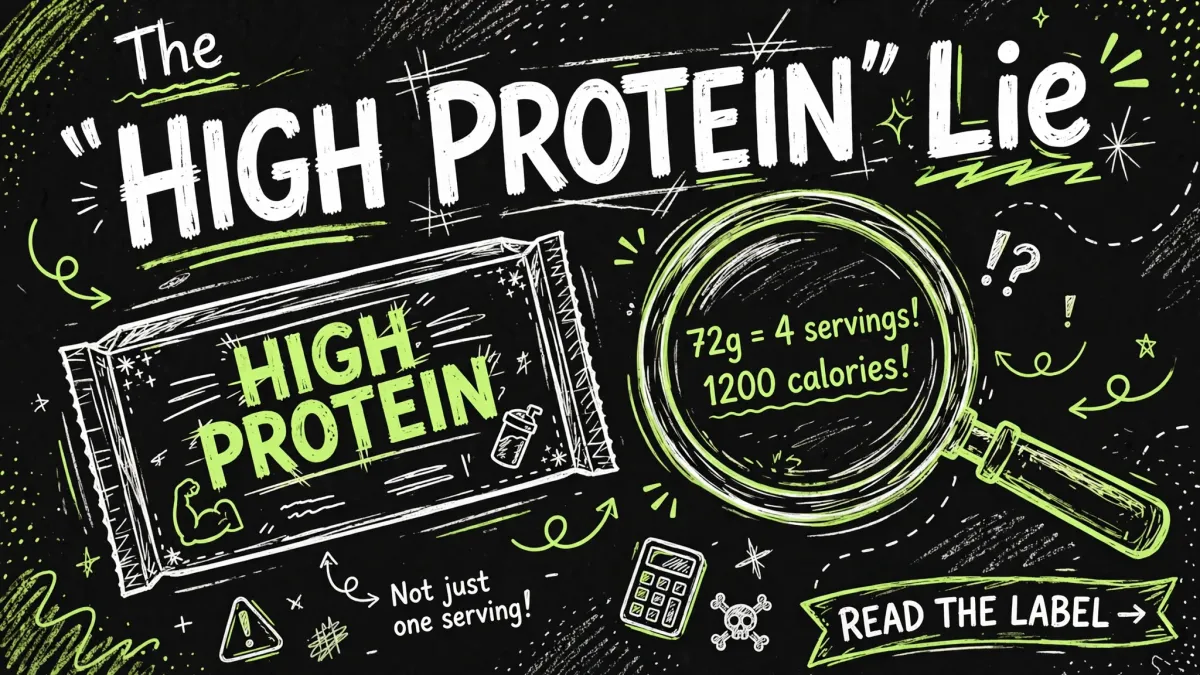
The "High Protein" Lie: How Food Marketing Tricks You
Walk down any grocery aisle right now and everything's screaming at you: HIGH PROTEIN. The cereal. The cookies. The snacks. The frozen meals.
Sounds great — until you flip the package over.
I saw a meal with "72 grams of protein" stamped big across the front. Sounds incredible, right? That's a serious number.
Then you read the label.
That's four servings. The whole package. It was 1400 hundred calories.
So you're spending nearly a full day's worth of calories to get 72 grams of protein. Let that sink in. For the calorie cost of almost everything you should eat in a day, you're getting a moderate amount of protein.
That's not high protein. That's just food with good marketing.
Why This Matters More Than You Think
Here's the thing — most people trying to lose weight or build muscle are told to "eat more protein." Good advice. So they grab the products yelling HIGH PROTEIN off the shelf, thinking they're doing the right thing.
But if you're spending 1,200 calories to get 72 grams of protein, you're blowing your calorie budget on food that isn't actually doing the job. You end up overeating calories while still undereating protein — the exact opposite of what you wanted.
The label didn't lie, technically. It just told you the truth in the most misleading way possible.
The Only Rule You Need
Never trust the front of the package. Ever.
Flip it over. Look at two numbers:
1. Protein per serving — not per package, not per "about four servings." Per serving.
2. What it costs you in calories — how many calories are you spending to get that protein?
That's the real math. A genuinely high-protein food gives you a lot of protein for relatively few calories. If the ratio is bad, the front label is just noise.
Real High-Protein Food Doesn't Need to Scream It
Think about it — chicken breast doesn't have "HIGH PROTEIN!!!" plastered across it in neon letters. Neither do eggs, Greek yogurt, or tuna. The foods that are actually high in protein don't need marketing to convince you.
It's the cookies, the cereal, and the snacks that need the costume. If a product has to shout about its protein content, that's your first clue to check the label.
Your Next Step
You don't need a nutrition degree to eat well. You need someone to show you what actually matters on a label — and build you a plan around real food, not marketing.
I do free 60-minute fitness assessments — in person in Lee's Summit, or online from anywhere. We'll talk about where you are, where you want to be, and what it's actually going to take to get there.
